
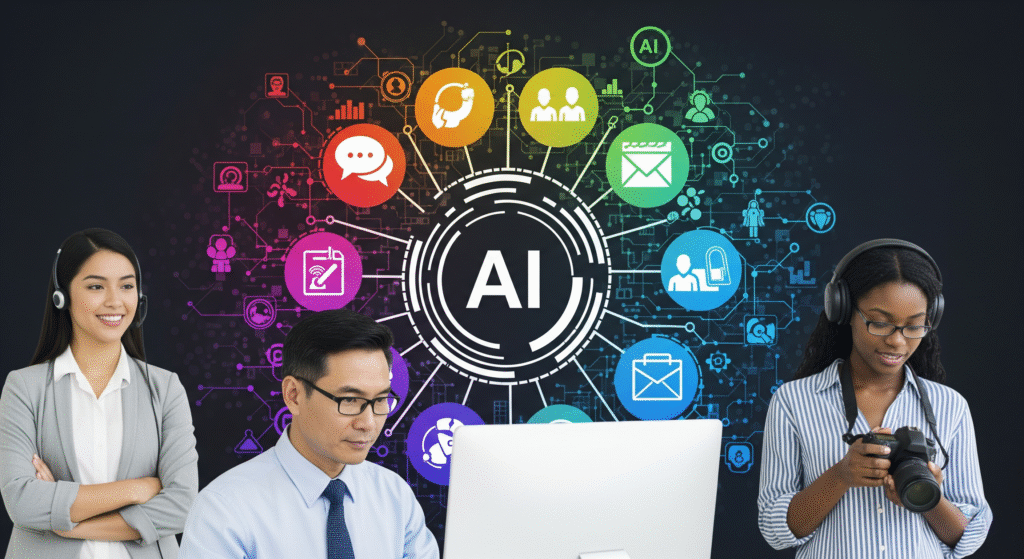
I get it. You’ve probably seen the headlines—”AI will replace 95% of customer interactions by 2025″ or “69% of data processing tasks could be automated.” If you’re a customer service rep, administrative professional, or entry-level marketer, those statistics might keep you up at night.
But here’s what those fear-mongering articles won’t tell you: Sarah, a customer service representative at a mid-sized tech company, just got promoted to Customer Experience Manager after mastering the art of working with AI, not against it. While her colleagues worried about chatbots taking their jobs, Sarah learned to leverage AI insights to have deeper, more meaningful conversations with customers. Her resolution rates increased by 40%, and her company created a whole new role just for her.
The truth? AI isn’t here to replace you—it’s here to amplify your uniquely human superpowers. And if you develop the right skills now, you’ll not only survive the AI revolution but thrive in it.
The Real Story About AI in Your Field
Let’s address the elephant in the room with some facts, not fear:
For Customer Service Reps: Yes, 80% of companies are using or planning to adopt AI-powered chatbots. But here’s the twist—mature AI adopters report 17% higher customer satisfaction because they’re using AI to enhance human agents, not replace them. Companies need people who can handle complex emotional situations, build trust, and solve problems that require genuine empathy.
For Data Entry & Admin Professionals: While AI can automate up to 38% of data entry tasks, it still can’t handle handwritten documents, complex decision-making, or quality assurance that requires human judgment. Instead of making these roles obsolete, AI is transforming them into higher-value positions focused on data analysis, process optimization, and strategic support.
For Entry-Level Content Creators: Sure, 43% of marketers use AI for content creation, but here’s the reality—AI content needs human creativity to truly connect with audiences. The most successful content marketers are those who use AI as a co-pilot for ideation and first drafts, then apply their creativity, cultural understanding, and brand voice to create content that actually resonates.
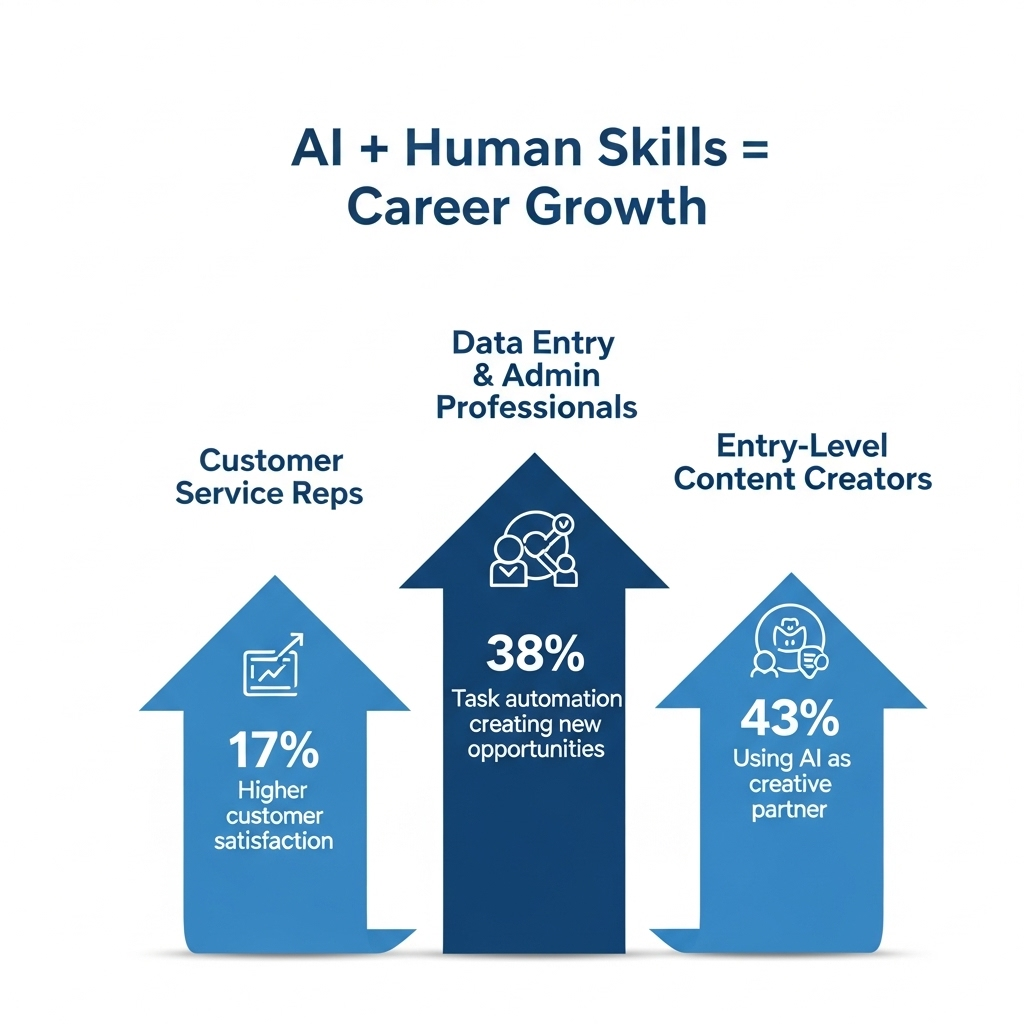
The key insight? AI is redefining these roles, not eliminating them. You just need to know which skills to develop to stay ahead of the curve.
Skill #1: Emotional Intelligence and Human Connection
Here’s the thing about AI: it can recognize emotions, but it can’t truly feel them. That’s your competitive advantage.
Why This Matters for Customer Service
Take Maria, a customer service rep at a telecommunications company. When AI chatbots started handling basic inquiries, she was worried. But then she realized something—the calls that reached her were now only the complex, emotionally charged situations. Customers who’d been bounced around by automated systems needed someone who could truly understand their frustration.
Maria started using AI-generated customer history insights to understand the emotional journey before the call even began. When Mrs. Johnson called about her internet being down for the third time, Maria could see the pattern and immediately acknowledged the frustration: “I can see this is your third call about connectivity issues, and I can imagine how incredibly frustrating that must be for someone running a home business. Let me personally ensure we solve this permanently today.”
That level of human connection? That’s irreplaceable.
How Data Entry Professionals Can Apply This
Even in data entry, emotional intelligence matters more than you think. When Jim, an administrative assistant, noticed discrepancies in expense reports, he didn’t just flag them—he approached colleagues with empathy, understanding that mistakes often happen due to stress or confusion rather than malice.
“I noticed a few questions with your expense report, and I know how overwhelming it can be to keep track of everything when you’re traveling constantly. Want to grab a coffee and we can sort through this together?” This approach led to better data accuracy and stronger working relationships across his organization.
Content Creators: Your EQ is Your Edge
AI can write copy, but it can’t understand why a particular message might be tone-deaf for your audience. When Lisa, a junior content creator at a wellness brand, used AI to draft social media posts, she caught something the AI missed—a post about “quick fixes” during Mental Health Awareness Month could be harmful.
Her emotional intelligence helped her reframe the content to focus on “small daily practices” instead, leading to the company’s most engaged post that month.

Developing Your Emotional Intelligence
Daily Practice for Customer Service Reps:
- Before each call, take a moment to understand the customer’s emotional state from their communication history
- Practice active listening by summarizing not just what the customer said, but how they might be feeling
- Use AI insights about past interactions to show genuine empathy: “I see you’ve been working on this issue for several days…”
For Administrative Professionals:
- When presenting data or reports, consider how the information might emotionally impact different stakeholders
- Practice reading between the lines—what’s the stress or concern behind the data request?
- Use your people skills to make data accessible and actionable for non-technical colleagues
For Content Creators:
- Before publishing AI-generated content, ask: “How would different segments of our audience emotionally respond to this?”
- Develop a deeper understanding of your brand’s voice by studying how it makes people feel, not just what it says
- Use AI for first drafts, but apply your emotional intelligence to add nuance, cultural sensitivity, and genuine human connection
Skill #2: Critical Thinking and Complex Problem-Solving
AI excels at pattern recognition, but it struggles with ambiguous, multi-layered problems that require human judgment. This is where you become indispensable.
Customer Service: Beyond Script Responses
Remember when customer service meant following a script? Those days are over. Today’s customer service requires detective work, creative problem-solving, and the ability to connect seemingly unrelated dots.
Take David, a customer service supervisor who noticed something AI missed: several customers were calling about different issues (billing, technical support, account access), but they all had one thing in common—they’d recently moved to apartments in the same zip code. His critical thinking led him to discover a localized service issue that the automated systems hadn’t flagged. By proactively reaching out to other customers in that area, he prevented dozens of additional complaints.
Administrative Professionals: The Strategic Data Detective
Janet, an administrative coordinator, wasn’t content just entering vendor invoices into the system. She started noticing patterns—certain suppliers had inconsistent pricing, some departments were ordering the same items from different vendors at different prices, and seasonal fluctuations weren’t being accounted for in budgeting.
Instead of just processing the data, she created a monthly report highlighting these insights, which led to renegotiated contracts and saved her company $50,000 annually. Her role evolved from data entry to strategic procurement support.
Content Creators: Strategy Behind the Content
While AI can generate blog posts and social media content, it can’t think strategically about why certain content should exist or how it fits into broader business objectives.
Marcus, a junior marketing coordinator, used AI to create initial content drafts but applied critical thinking to ask deeper questions: “Why is our engagement dropping despite consistent posting? What isn’t our audience telling us directly? How do our content themes align with customer journey stages?”
His analysis revealed that while AI-generated content was technically good, it wasn’t addressing the real concerns potential customers had during the consideration phase. By using critical thinking to identify this gap, he developed a content strategy that increased qualified leads by 60%.
[IMAGE: A puzzle with pieces representing different data points being assembled by human hands, while AI provides supporting analysis in the background. Include thought bubbles showing questions like “Why?” “What if?” “How does this connect?” Style: analytical, problem-solving focus, bright lighting.]

Building Your Critical Thinking Skills
The 5-Why Method for Customer Service: When a customer presents a problem, don’t stop at the surface issue:
- Why is the customer calling? (Their account is locked)
- Why is their account locked? (Multiple failed login attempts)
- Why multiple failed attempts? (They forgot their password)
- Why did they forget? (They recently changed it due to security concerns)
- Why security concerns? (They received a phishing email that looked legitimate)
This reveals the real issue: customer education about phishing, not just account access.
Data Analysis for Admin Professionals:
- Before entering data, ask: “What story is this data telling?”
- Look for patterns across time: “Why do certain trends repeat?”
- Consider connections: “How might this data relate to other departments or processes?”
- Question assumptions: “What if the data is showing us something unexpected?”
Strategic Content Thinking:
- Before creating content, ask: “What specific problem does this solve for our audience?”
- Consider timing: “Why is this the right message at this moment?”
- Think about gaps: “What isn’t being said that should be?”
- Evaluate effectiveness: “How will we know if this content actually works?”
Skill #3: Adaptability and Continuous Learning
The AI landscape changes monthly, not yearly. Your ability to learn and adapt is what keeps you valuable as technology evolves.
Customer Service: Riding the Wave of Change
Elena started as a phone support agent in 2023. By 2024, her company introduced AI chatbots for tier-1 support. Instead of resisting, she volunteered to help train the AI system and learn how to work alongside it.
When customers escalated from the chatbot to her, she had full context of the AI conversation and could seamlessly continue where it left off. But she didn’t stop there—she taught herself basic data analysis to understand chatbot performance metrics, which led to her promotion to AI Training Specialist, a role that didn’t exist a year earlier.
Administrative Professionals: From Task Executors to Process Optimizers
Kevin was initially worried when his company implemented AI for invoice processing. But instead of seeing it as a threat, he saw it as an opportunity to level up his skills. He learned how to work with the AI system, became the go-to person for training colleagues, and started identifying processes that could be further optimized.
When the AI flagged unusual spending patterns, Kevin investigated and discovered vendor pricing discrepancies. His ability to adapt and learn new technology transformed him from an invoice processor to a financial analyst assistant—with a 30% salary increase.
Content Creators: The AI-Human Creative Partnership
Sophia, a social media coordinator, initially felt threatened when her agency started using AI content tools. But she reframed her thinking: instead of competing with AI, she’d become an expert at directing it.
She learned prompt engineering, studied how to get better outputs from AI tools, and developed a system for quickly editing AI-generated content to match her brand’s voice. She became so efficient that she could manage content for three additional clients, making her indispensable to her agency.

Creating Your Continuous Learning System
The 1% Better Daily Method:
- Week 1: Spend 15 minutes daily exploring one new AI tool relevant to your field
- Week 2: Practice using that tool for actual work tasks
- Week 3: Find ways to combine the AI tool with your existing skills
- Week 4: Teach someone else what you’ve learned (this solidifies your knowledge)
Learning Resources by Role:
Customer Service Professionals:
- Learn basic data analysis (Google Analytics, Excel pivot tables)
- Understand AI chatbot capabilities and limitations
- Study customer journey mapping and experience design
- Explore CRM integrations and automation tools
Administrative Professionals:
- Master advanced Excel/Google Sheets functions
- Learn basic project management tools (Asana, Monday.com)
- Understand data visualization (creating simple charts and dashboards)
- Explore process automation tools (Zapier, Microsoft Power Automate)
Content Creators:
- Master prompt engineering for AI writing tools
- Learn basic SEO and content analytics
- Understand social media automation tools
- Study brand voice development and content strategy frameworks
The Growth Mindset in Action
The most successful professionals I’ve met share one trait: they see AI as a learning partner, not a replacement threat. They ask questions like:
- “How can this AI tool make me more effective at the parts of my job I love most?”
- “What new skills can I develop that complement what AI does well?”
- “How can I become the bridge between AI capabilities and human needs?”
Skill #4: Creative Problem-Solving and Innovation
Here’s where humans shine brightest: taking disparate information and creating novel solutions. AI can optimize existing processes, but it can’t imagine entirely new approaches.
Customer Service: Innovating the Experience
When COVID-19 hit, call volumes at Rachel’s insurance company increased 300%. The AI systems were overwhelmed, and customers were frustrated with long wait times. Instead of just dealing with the chaos, Rachel proposed something creative.
She suggested implementing “smart queuing”—using AI to identify the emotional urgency of calls (not just technical urgency) and creating specialized callback options for different customer types. Elderly customers could choose a “patient explanation” callback, busy parents could opt for “quick resolution,” and tech-savvy customers could choose “self-service guided support.”
This human-designed, AI-supported solution reduced average call times by 40% and increased customer satisfaction scores to their highest levels ever.
Administrative Excellence Through Innovation
Tom noticed that his company’s expense reporting process was a nightmare—even with AI handling receipt scanning, employees were still confused about categories, approval workflows varied by department, and reports often got stuck in bureaucratic limbo.
His innovative solution? He created a simple “Expense Report Story” system. Instead of complex forms, employees could describe their expenses in plain language: “I took three clients to dinner at Morton’s Steakhouse to discuss the Johnson contract.” The AI would parse this into proper categories, but Tom’s human insight was designing a system that worked with how people naturally think about their expenses.
The result? 70% reduction in expense report errors and 50% faster processing times.
Content Creation: Beyond AI Generation
While her colleagues were using AI to pump out generic blog posts, Amy took a different approach. She used AI as a research assistant and idea generator, but her creative insight was recognizing that her audience—small business owners—were overwhelmed by generic marketing advice.
She created a content series called “Marketing Reality Check,” where she took popular AI-generated marketing tips and tested them with real small businesses, documenting what actually worked and what was just theoretical fluff. This human-led, AI-supported approach made her company’s blog the go-to resource in their industry.

Developing Your Creative Problem-Solving Skills
The SCAMPER Method for Workplace Innovation:
Substitute: What can I replace or substitute in our current process?
- Customer Service: Replace hold music with educational content about common solutions
- Admin: Substitute complex approval chains with smart routing based on request type
- Content: Replace generic stock photos with employee-generated authentic visuals
Combine: What can I combine to create something new?
- Customer Service: Combine AI chat logs with customer sentiment data to predict escalation risk
- Admin: Combine expense data with project timelines to identify budget optimization opportunities
- Content: Combine AI-generated first drafts with user-generated content for authentic storytelling
Adapt: What can I adapt from other industries or contexts?
- Customer Service: Adapt restaurant reservation systems for customer callback scheduling
- Admin: Adapt retail inventory management for office supply optimization
- Content: Adapt storytelling techniques from entertainment for B2B content
Creative Exercises for Your Role
Weekly Innovation Hour: Block one hour weekly to explore “What if?” scenarios:
- What if we could solve this problem by doing the opposite of what everyone expects?
- What if we combined our biggest challenge with our biggest strength?
- What if we approached this like [insert completely different industry] would?
Customer Service Innovation:
- Shadow customers through their entire journey and identify friction points AI might miss
- Create “empathy maps” for different customer types
- Brainstorm non-obvious solutions to common problems
Administrative Innovation:
- Map information flows and identify bottlenecks
- Question every “we’ve always done it this way” assumption
- Propose pilot programs for process improvements
Content Creation Innovation:
- Experiment with new content formats AI can’t easily replicate (interactive content, behind-the-scenes stories, live Q&As)
- Create content frameworks that blend AI efficiency with human creativity
- Develop unique brand voice elements that make AI-generated content distinctly yours
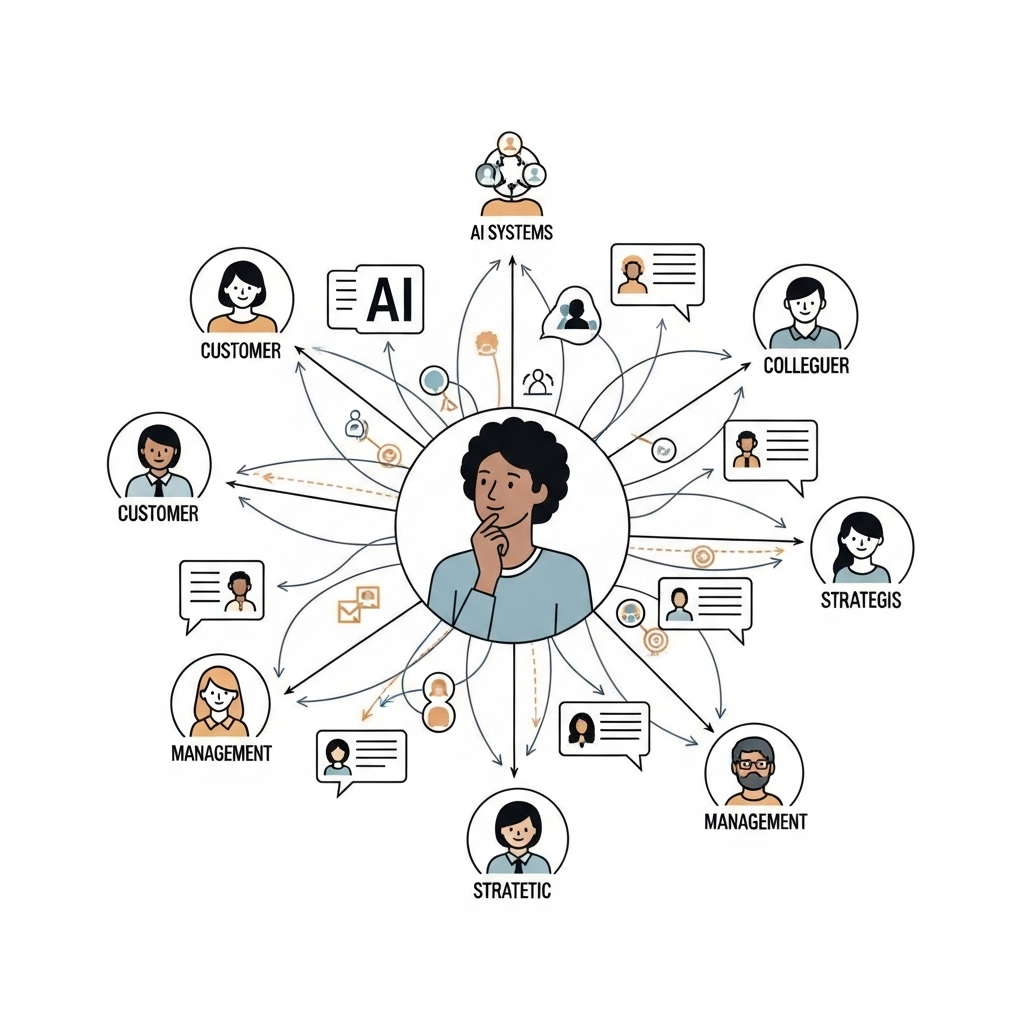
Skill #5: Strategic Communication and Relationship Building
AI can process information and even generate responses, but it can’t build genuine relationships, navigate office politics, or communicate with the nuance that human relationships require.
Customer Service: Building Relationships at Scale
While AI handles transactional interactions, your role becomes building genuine connections that create loyalty. Consider how Lisa, a customer success representative at a software company, transformed her approach.
Instead of just solving tickets, she started recognizing patterns in customer behavior. When she noticed a customer hadn’t used a key feature in months, she’d proactively reach out—not with a sales pitch, but with genuine curiosity: “Hi John, I noticed you haven’t been using our reporting feature lately. I remember you mentioning last quarter how important data visibility was for your team. Did you run into any challenges with it, or has your workflow changed?”
This type of strategic, relationship-focused communication led to a 40% increase in customer retention in her portfolio and eventually to her promotion to Customer Success Manager.
Administrative Professionals: The Organizational Connector
Administrative professionals who thrive alongside AI understand that their real value lies in being organizational connectors—people who understand relationships, politics, and communication flow in ways AI cannot.
Take Sandra, an executive assistant who transformed her role by becoming the strategic communication hub for her department. When different teams needed to collaborate on AI-driven projects, she didn’t just schedule meetings—she prepared briefing documents that translated technical AI concepts into business language for executives, and business requirements into actionable tasks for technical teams.
Her ability to facilitate understanding between different stakeholders made her indispensable during the company’s digital transformation.
Content Creators: The Voice Behind the Brand
AI can generate content, but it can’t understand the subtle nuances of brand personality, cultural context, or the unspoken relationships between a brand and its community.
Miguel, a content coordinator for a local restaurant chain, used AI to handle basic social media posting schedules and blog drafts. But his human touch was in community management—responding to comments in a way that felt authentically local, sharing behind-the-scenes stories that AI couldn’t know, and navigating sensitive situations with cultural awareness.
When a food critic posted a negative review, Miguel’s response didn’t come from an AI template. He acknowledged the criticism specifically, shared what the restaurant was doing to improve, and invited the critic back for a conversation. That human touch turned a potential PR disaster into a demonstration of the restaurant’s commitment to excellence.
Building Strategic Communication Skills
The CLEAR Communication Framework:
Context: Always provide the right amount of background
- Customer Service: “Based on our previous conversations about X, I understand Y is important to you…”
- Admin: “Given the upcoming deadline for the quarterly report, this data request will help ensure…”
- Content: “Following up on the engagement we saw with last week’s post about sustainability…”
Logic: Connect your message to clear reasoning
- Customer Service: “Because this issue affects your core workflow, I’m prioritizing it and bringing in our senior tech specialist…”
- Admin: “Since this process change will impact three departments, I’ve scheduled alignment meetings with each team lead…”
- Content: “Given our audience’s interest in practical tips, I’m focusing this series on actionable strategies rather than theory…”
Emotion: Acknowledge and address the emotional component
- Customer Service: “I can imagine how frustrating it must be to deal with this repeatedly…”
- Admin: “I know change can be stressful, so I’ve created a step-by-step guide to make the transition smoother…”
- Content: “We know starting a new project can feel overwhelming, so let’s break this down into manageable steps…”
Action: Be clear about next steps
- Customer Service: “Here’s exactly what I’m going to do next, and here’s when you’ll hear from me again…”
- Admin: “I’ll have the analysis ready by Thursday morning, and I’ll include three recommendation options…”
- Content: “In next week’s post, we’ll dive deeper into implementation strategies, and I’ll include a downloadable checklist…”
Results: Connect to outcomes that matter
- Customer Service: “This solution will prevent this issue from happening again and save you time in the long run…”
- Admin: “This new process will reduce approval time from five days to two days…”
- Content: “This content series will help our audience feel more confident implementing these strategies…”
Relationship Building in the AI Era
The Trust Building Method:
Consistency: Be reliable in your communication patterns
- Respond within promised timeframes
- Keep stakeholders updated on progress
- Maintain consistent quality in your interactions
Competence: Demonstrate expertise while staying humble
- Share insights that add value beyond the immediate task
- Admit when you don’t know something and commit to finding out
- Use AI tools to enhance your expertise, not replace your judgment
Connection: Show genuine interest in others’ success
- Remember personal details that matter to colleagues and customers
- Celebrate others’ wins and acknowledge their contributions
- Ask thoughtful questions that show you’re listening
Courage: Address difficult issues with tact and honesty
- Bring up problems before they become crises
- Provide constructive feedback that helps others improve
- Stand up for what’s right, even when it’s uncomfortable
Bringing It All Together: Your 90-Day AI-Resilient Career Plan
The five skills we’ve covered—emotional intelligence, critical thinking, adaptability, creativity, and strategic communication—work together to create a professional profile that becomes more valuable as AI advances, not less.
Days 1-30: Foundation Building
Week 1: Emotional Intelligence Foundation
- Customer Service: Complete an empathy mapping exercise for your top 3 customer types
- Administrative: Practice reading emotional cues in email communications and responding appropriately
- Content Creation: Analyze your brand’s content for emotional resonance and identify gaps
Week 2: Critical Thinking Kickstart
- Customer Service: Start using the 5-Why method on customer issues
- Administrative: Begin questioning data patterns and looking for insights beyond surface-level information
- Content Creation: Ask strategic questions before creating any content: Why this? Why now? Why us?
Week 3: Adaptability Assessment
- All Roles: Identify one AI tool relevant to your work and spend 30 minutes daily learning it
- Set up news alerts for AI developments in your industry
- Find one online course or tutorial to expand your digital skills
Week 4: Creative Problem-Solving Practice
- All Roles: Apply the SCAMPER method to one recurring workplace challenge
- Schedule your weekly “Innovation Hour”
- Document three creative solutions you implement, no matter how small
Days 31-60: Skill Integration
Week 5-6: AI-Human Collaboration
- Customer Service: Learn to use AI customer insights to enhance your empathetic responses
- Administrative: Start using AI tools for data processing while applying critical thinking to interpret results
- Content Creation: Develop a system for using AI for ideation while applying your creativity to execution
Week 7-8: Strategic Communication
- All Roles: Implement the CLEAR communication framework in all professional interactions
- Practice translating AI insights into human-friendly language
- Build stronger relationships with colleagues and customers by showing genuine interest in their success
Week 9-10: Advanced Application
- All Roles: Lead one project or initiative that combines AI efficiency with human insight
- Document the value you’re creating by working with AI rather than being replaced by it
- Share your learnings with colleagues (this reinforces your own understanding)
Days 61-90: Mastery and Growth
Week 11-12: Strategic Positioning
- All Roles: Position yourself as the AI-human collaboration expert in your workplace
- Propose new ways your organization can better leverage the AI-human partnership
- Start tracking metrics that demonstrate your enhanced value
Week 13: Future Planning
- Assess your progress across all five skills
- Identify which skills need continued development
- Plan your next 90-day learning cycle
- Consider how these skills might position you for internal promotions or new opportunities
Making It Stick: Daily Habits for Long-Term Success
The 15-Minute Daily Practice:
- 5 minutes: Learn something new about AI in your field
- 5 minutes: Practice one of the five skills (rotate daily)
- 5 minutes: Reflect on how you can apply today’s learning to improve tomorrow’s work
Weekly Reflection Questions:
- How did I use AI to enhance rather than replace my human skills this week?
- What creative solution did I implement that AI couldn’t have thought of?
- How did my emotional intelligence make a difference in my interactions?
- What did I learn that I can teach someone else?
- How am I becoming more valuable as AI becomes more prevalent?
The Future Belongs to AI-Human Collaborators
Here’s what I want you to remember: the professionals thriving in 2025 aren’t those avoiding AI—they’re those who’ve mastered the art of AI-human collaboration. They use AI to handle routine tasks while they focus on strategy, relationships, and creative problem-solving.
Your emotional intelligence guides AI insights into meaningful customer connections. Your critical thinking questions AI assumptions and finds deeper insights. Your adaptability helps you stay current with evolving technology. Your creativity builds on AI suggestions to create truly innovative solutions. Your communication skills translate AI capabilities into human understanding and trust.
Success Stories from the Field
Jennifer (Customer Service → Customer Experience Designer): Started as a call center rep, used AI analytics to identify customer pain points, applied human insight to design better experiences. Now leads CX strategy for her company.
Carlos (Data Entry → Business Intelligence Analyst): Began entering invoices, learned to work with AI processing tools, applied critical thinking to identify cost-saving opportunities. Became a strategic advisor to management.
Priya (Social Media Coordinator → Brand Strategist): Started posting scheduled content, mastered AI content tools, applied creativity and strategic thinking to develop brand voice that AI couldn’t replicate. Now leads brand strategy for multiple clients.
Your Next Steps Start Now
The AI revolution isn’t coming—it’s here. But instead of fearing it, you now have a roadmap to thrive in it. The five skills in this guide aren’t just about surviving automation; they’re about becoming so valuable that AI makes you irreplaceable.
The question isn’t whether AI will change your industry—it’s whether you’ll be ready to lead that change.
Start with one skill. Pick one exercise. Take one step today.
Because while AI is learning to mimic human capabilities, you’re developing the uniquely human skills that can’t be automated: the ability to truly understand, create, connect, and lead.
Your career isn’t at risk from AI—it’s about to be amplified by it.
Which of these skills resonates most with your current role? Share your thoughts in the comments below, and let’s build a community of professionals who are thriving alongside AI rather than fearing it. What’s your biggest challenge in developing these skills? I’d love to hear your story and help you navigate this exciting transformation.