
The future of work is here, and it’s more complex than anyone predicted. While the World Economic Forum’s Future of Jobs Report 2025 reveals that 170 million new roles will be created by 2030, 92 million jobs will be displaced, creating a net increase of 78 million jobs globally.
But here’s what matters most: not all careers face the same risk. Stanford University research found the key dividing line: AI struggles with tasks requiring genuine human emotion, creativity, physical dexterity, and ethical judgment. These four human superpowers create a protective barrier between you and automation.
Sarah Kim, a nurse practitioner in Seattle, recently shared her experience: “AI can process medical data faster than any human, but yesterday I caught a rare cardiac condition that multiple diagnostic tools missed. The patient said they felt ‘different’ – not typical symptoms. I listened to the fear in their voice and ordered additional tests. That human intuition saved a life.”
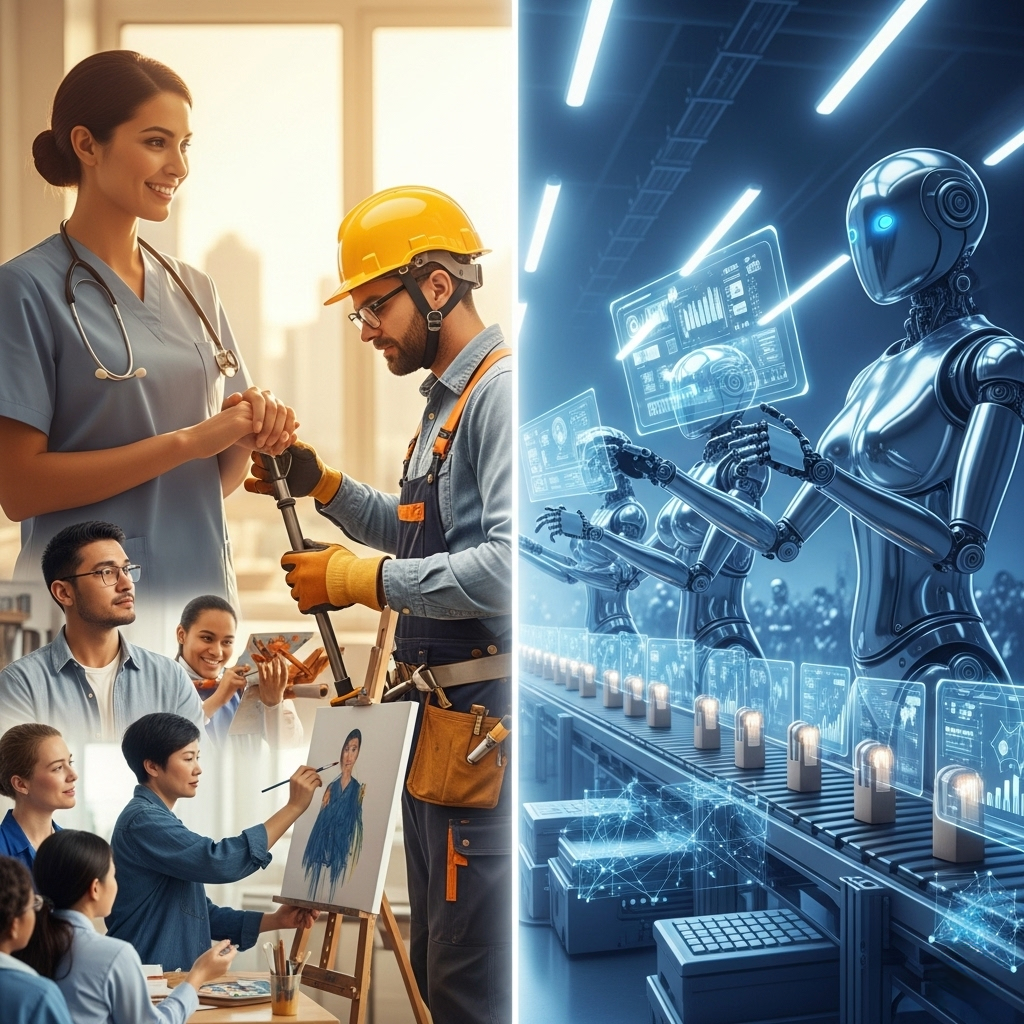
This story illustrates why certain careers remain fundamentally human. Let’s explore 15 jobs that showcase irreplaceable human skills in an AI-driven world.
The Science Behind AI-Proof Jobs
Before diving into specific careers, understanding what makes jobs automation-resistant is crucial. AI thrives with structured, repetitive tasks, but careers demanding creativity, emotional intelligence, and adaptability remain far out of reach for AI systems.
Four key factors determine AI resistance:
Human Interaction: Careers requiring empathy, trust-building, and emotional intelligence Complex Problem-Solving: Roles demanding nuanced, situational decisions Creative Thinking: Jobs needing human originality and contextual understanding Physical Presence: Work requiring on-site expertise and manual dexterity
1. Nurse Practitioners – The Healthcare Heroes
Why They’re AI-Proof: Nurse practitioners are projected to grow 45.7% by 2032, with a median annual wage of $120,680. Their role combines clinical expertise with patient-centered care requiring split-second decisions based on subtle human cues.
The Human Edge: While AI can monitor vital signs and suggest treatments, it cannot interpret unspoken communication, cultural context, or provide the authentic human connection that forms the foundation of healthcare.
Career Path: Requires a Master’s or doctoral degree in nursing, but the ROI is exceptional given the growth rate and salary potential.
2. Mental Health Counselors – Masters of Human Connection
Why They’re AI-Proof: Mental health counselors show 22.1% growth, with marriage and family therapists showing 13.9% growth. While AI-powered chatbots may help with basic support, therapy requires the ability to build trust, interpret non-verbal cues, and provide authentic human connection.
The Human Edge: Mental health care relies heavily upon deep interpersonal connections and a nuanced understanding of complex emotions—qualities that machines cannot fully emulate.
Career Path: Typically requires a Master’s degree in psychology, counseling, or social work.
3. Skilled Trades – The Hands-On Problem Solvers
Why They’re AI-Proof: Skilled trades represent some of the most automation-resistant careers due to their physical complexity and unpredictable environments. Over 663,000 openings are projected yearly in construction and extraction fields through 2033.
The Human Edge: Skilled trades involve complex, site-specific problem-solving and hands-on expertise that are challenging to replicate. Every job site presents unique challenges requiring human judgment and craftsmanship.
Career Path: Typically requires certification, apprenticeship, and licensure. AI-proof careers include electricians, plumbers, carpenters, and HVAC technicians.
4. Teachers – The Irreplaceable Mentors
Why They’re AI-Proof: Post-secondary teachers show projected growth around 8% through 2033, with specialties like nursing instructors showing 21.5% growth. Teaching requires understanding of complex human emotions and the ability to make nuanced decisions based on subtle cues.
The Human Edge: AI can’t replace the patience, encouragement, and connection a good teacher provides. Teaching is about more than delivering knowledge; it’s about inspiring students to learn and grow.
Career Path: Education requirements vary, but typically require a bachelor’s degree in your chosen field, with professors often requiring advanced degrees.
5. Physical Therapists – The Healing Touch
Why They’re AI-Proof: Physical therapists show 16.9% growth, occupational therapists 13.9% growth, and athletic trainers 17.5% growth. Healthcare stands out with remarkably low automation risk – occupational therapists face less than 1% chance of AI replacement.
The Human Edge: Occupational therapists help people recover from injuries or disabilities through hands-on care and empathy. This direct human involvement makes the role difficult for AI to automate.
Career Path: Usually requires a doctorate for physical therapists, master’s for occupational therapists.
6. Cybersecurity Specialists – The Digital Guardians
Why They’re AI-Proof: Cybersecurity shows 33% projected growth through 2033 as human judgment remains essential for threat response. The BLS estimates a 33% growth in cybersecurity roles by 2033, making it one of the most future-proof IT careers.
The Human Edge: Human judgment remains essential for threat response, especially in complex and high-pressure environments like breach response.
Career Path: Combines technical certifications with hands-on experience, making it accessible for IT professionals concerned about automation.
7. Creative Professionals – The Imaginative Innovators
Why They’re AI-Proof: Adobe research found that 94% of creative professionals now use AI tools, but 86% report these tools enhance rather than replace their creative work. Writers, artists, and designers draw from personal experiences, emotions, and cultural contexts to create original work.
The Human Edge: AI tools can generate art, music, and written content, but they can’t replace the ingenuity and originality of human creativity.
Career Path: Most creative careers require a bachelor’s degree along with a strong portfolio, with salaries ranging from $40,000 to $100,000+ annually.
8. Data Scientists – The Strategic Analysts
Why They’re AI-Proof: Employment for data scientists is projected to grow by 36% between 2023 and 2033. AI can generate outcomes, but it cannot decide what data matters, how it should be collected, or how models should be trained to behave ethically.
The Human Edge: Data scientists provide the strategic thinking and ethical oversight that AI systems require to function effectively.
Career Path: Typically requires advanced degrees in statistics, computer science, or related fields.
9. Social Workers – The Human Safety Net
Why They’re AI-Proof: Social work relies on deep emotional intelligence and the ability to navigate complex interpersonal situations. These professionals make life-altering decisions requiring human judgment and cultural understanding.
The Human Edge: Social workers build trust with vulnerable populations and make complex ethical decisions that consider the full human context of each situation.
Career Path: Typically requires a bachelor’s degree in social work, with many positions requiring a master’s degree.
10. Choreographers – The Movement Artists
Why They’re AI-Proof: Choreographers show projected growth of 29.7% by 2032, requiring creativity, originality, and social skills. Creative movement and expression make choreography one of the strongest AI-proof careers.
The Human Edge: The expressions, agility, and precise movements portrayed by professional dancers and theatre artists cannot be reenacted by AI.
Career Path: Requires extensive training in dance and movement, with opportunities in theater, film, and live performance.
11. Emergency Responders – The Crisis Heroes
Why They’re AI-Proof: Emergency services like firefighters, police, and first responders face unpredictable situations requiring quick thinking and fine motor skills. Firefighting jobs show stable growth with a projected 4% increase from 2023 to 2033.
The Human Edge: Emergency situations require split-second decision-making, physical courage, and the ability to remain calm under extreme pressure while adapting to rapidly changing circumstances.
Career Path: Requires specialized training and certifications, with clear advancement opportunities from firefighter to management positions.
12. Lawyers and Judges – The Justice Advocates
Why They’re AI-Proof: While AI can assist with legal research and document review, it can’t replace the strategic thinking and advocacy provided by lawyers and judges. Human empathy and ethical considerations make complete replacement unlikely.
The Human Edge: Legal decisions require understanding human motivation, cultural context, and the ability to balance competing interests while considering broader societal implications.
Career Path: Requires a juris doctor (JD) degree, with paralegals needing associate degrees and certification.
13. Scientists and Researchers – The Discovery Pioneers
Why They’re AI-Proof: AI accelerates data analysis, but scientific discovery relies on human curiosity, hypothesis generation, and ethical considerations. The creativity, intuition, and scientific judgment necessary for ground-breaking discoveries are uniquely human.
The Human Edge: Research involves asking the right questions and interpreting results in ways that AI cannot achieve, requiring human insight and creative problem-solving.
Career Path: Most research careers require master’s degrees or PhDs, with salaries ranging from $60,000 to $120,000+ depending on specialization.
14. Hospitality Managers – The Experience Creators
Why They’re AI-Proof: While AI can enhance efficiency in hospitality, customer-facing roles require empathy, adaptability, and cultural awareness. The personal touch that hospitality demands—anticipating guest needs, resolving complaints, and creating memorable experiences—remains irreplaceable.
The Human Edge: Hospitality requires emotional intelligence, cultural sensitivity, and the ability to create authentic human connections that make experiences memorable.
Career Path: Education requirements vary, but most positions require a bachelor’s degree with on-the-job training.
15. Personal Trainers – The Fitness Motivators
Why They’re AI-Proof: Personal connection is the life-blood of good fitness training. AI fitness apps might generate workout plans, but they lack the human touch that gets real results.
The Human Edge: Personal trainers provide motivation, adapt to individual needs, and create accountability that AI cannot replicate.
Career Path: Requires certification and ongoing education, with opportunities for specialization in various fitness areas.
Future-Proofing Your Career: Essential Skills for the AI Era
The World Economic Forum reports that 39% of existing skill sets will become outdated between 2025-2030, making continuous learning essential. Here are the key skills to develop:
Top Growing Skills:
- AI and Big Data: Understanding how to work with AI tools
- Creative Thinking: Developing original solutions to complex problems
- Emotional Intelligence: Building stronger human connections
- Resilience and Adaptability: Thriving in changing environments
- Leadership and Social Influence: Guiding teams through transformation
Practical Steps:
- Invest in hybrid skills: Professionals with “hybrid skill sets” command 40% higher salaries and show 58% more resilience during economic downturns
- Focus on human-centered capabilities: Develop empathy, creativity, and ethical reasoning
- Learn to work with AI: Think of AI as your co-pilot, not your competition
- Pursue continuous learning: 85% of employers plan to prioritize workforce upskilling
The Bottom Line: Your Human Skills Are Your Superpower
While 40% of employers expect to reduce their workforce where AI can automate tasks, the key is positioning yourself in roles that leverage uniquely human capabilities. Success will come to those who can balance technological advancement with human development.
The future belongs to professionals who can work alongside AI while maintaining their human edge. These 15 career paths represent more than job security – they showcase what makes us irreplaceable in an automated world.
Whether you’re starting your career or considering a change, focus on developing the human skills that AI cannot replicate: creativity, empathy, adaptability, and ethical judgment. These abilities will not only protect your career but position you to thrive in the intelligent age.
The question isn’t whether AI will change work – it’s whether you’ll be ready to claim your place as an irreplaceable human in that future.
Ready to future-proof your career? Start by identifying which human skills you want to develop and take action today. The future is human, and it starts with you.